Log temperature over Wi-Fi
Reading a temperature (and humidity and pressure) sensor such as the Bosch BME280 over I2C from a Wi-Fi-capable board, and sending readings over Wi-Fi. Documented Wi-Fi options include ESP32-DevKitC and Arduino UNO R4 WiFi; the receiving logger is not covered.
Technologies that could fit
Suggestions only, not a recommendation. Check each record for limits.

Bosch BME280
Bosch Sensortec BME280: combined digital humidity, pressure and temperature sensor in a 2.5 x 2.5 x 0.93 mm LGA package with I2C and SPI interfaces and a 1.71-3.6 V supply.
Evidence: Inferred

ESP32-DevKitC
Small Espressif development board with an ESP32-WROOM/WROVER module, USB-to-UART bridge and breadboard-friendly headers.
Evidence: Inferred
ESP-IDF
Espressif's development framework for ESP32-family SoCs: toolchain, build tools (CMake and Ninja), libraries including Wi-Fi, and an idf.py command-line workflow for building, flashing and monitoring.
Evidence: Inferred
MicroPython
Lean implementation of Python 3 for microcontrollers, with an interactive REPL, a 'machine' module for hardware access, and documented ports including ESP32 and Raspberry Pi RP2xxx (Pico).
Evidence: Inferred
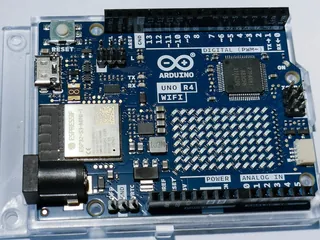
Arduino UNO R4 WiFi
UNO-form-factor board with a Renesas RA4M1 (48 MHz Cortex-M4, 5 V) plus an ESP32-S3 module for Wi-Fi and Bluetooth, USB-C and a 12x8 LED matrix.
Evidence: Inferred
Arduino IDE
Arduino's desktop programming environment for writing sketches and uploading them to Arduino boards; IDE 2.x is open source and adds autocompletion, code navigation and a debugger, with Serial Monitor, Serial Plotter, library and board managers.
Evidence: Inferred
Caveats
Scope: low-voltage sensor logging only; no mains or safety-critical guidance. The destination that stores or displays the readings is not covered because no primary source was read for it. Wiring, libraries and code are untested here. Wi-Fi security and network setup are not covered. skill_level and budget_band are not set because no primary source states them. Logic level depends on the board: ESP32-DevKitC GPIO is 3.3 V; on the UNO R4 WiFi the RA4M1 side (including A4/A5 I2C) is 5 V logic per the datasheet (VDD is connected to the 5V rail). The UNO R4 WiFi Qwiic connector is powered via 3.3 V (datasheet section 10); the datasheet does not state the Qwiic bus signal level.